
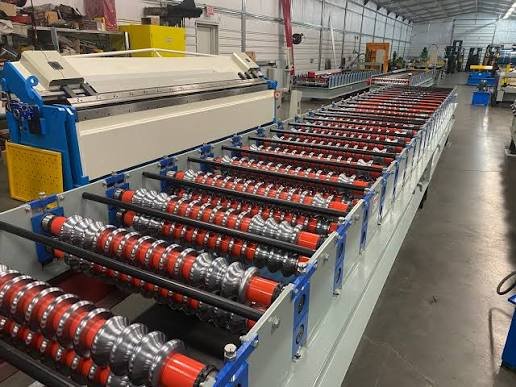
Modern manufacturing requires flexibility, precision, and efficiency to meet the growing demands of different industries. Businesses often work with specialized materials, unique product designs, and specific production requirements that standard machinery cannot fully accommodate. In such situations, investing in Custom Roll Forming Machines can be an effective solution. These machines are designed to meet particular manufacturing needs, allowing businesses to produce specialized metal profiles with greater accuracy, consistency, and efficiency.
Unlike standard roll forming equipment, customized systems can be developed around a company’s production goals, material specifications, profile dimensions, and operational requirements. This flexibility makes them valuable for manufacturers seeking improved productivity and better control over their manufacturing processes.
Understanding Custom Roll Forming Machines
Roll forming is a continuous metalworking process in which flat metal sheets or coils pass through a series of rollers. Each roller gradually shapes the material until it reaches the desired profile. The process is widely used to manufacture metal components for construction, automotive, electrical, agricultural, and industrial applications.
Custom Roll Forming Machines take this process further by incorporating specialized designs and configurations. Manufacturers can adjust the machine’s structure, roller arrangements, production speed, cutting systems, and automation features according to their requirements.
For example, a company producing unusual roofing profiles may require different roller stations and forming specifications than a manufacturer producing automotive structural components. Customized machinery makes it possible to accommodate these differences without relying on unsuitable standard equipment.
1. Designed Around Specific Production Requirements
One of the biggest advantages of customized roll forming equipment is its ability to address unique manufacturing challenges. Every production facility has different requirements depending on its products, materials, available workspace, and expected output.
Standard machines generally come with predefined configurations. Although they can handle common manufacturing applications, they may not provide the flexibility needed for specialized profiles.
Custom Roll Forming Machines are developed according to the manufacturer’s exact specifications. Businesses can select suitable machine dimensions, forming stations, roller designs, and production capabilities.
This tailored approach helps manufacturers produce components that meet precise technical requirements while reducing the need for unnecessary adjustments or additional processing equipment.
2. Greater Precision and Product Consistency
Precision is essential in metal forming because even small dimensional variations can affect the quality and functionality of finished components. Industries that manufacture structural parts, specialized panels, and precision metal sections require consistent results throughout production.
Customized roll forming systems can incorporate roller configurations designed specifically for the required profile. This helps maintain accurate dimensions, controlled material movement, and consistent forming performance.
When properly engineered and maintained, these machines can reduce unwanted variations between production batches.
Improved consistency also makes quality control easier. Manufacturers can establish repeatable production settings and maintain uniform standards across large manufacturing orders.
3. Flexibility for Unique Metal Profiles
Different industries require different metal shapes and configurations. Some products feature simple channels, while others require complex bends, multiple sections, grooves, or specialized structural designs.
Standard roll forming equipment may struggle to accommodate unusual profile requirements without significant modifications.
Custom Roll Forming Machines offer greater design flexibility because their roller tooling and forming arrangements can be developed for specific applications.
Manufacturers can produce specialized profiles for:
- Roofing and wall cladding systems
- Door and window frames
- Automotive structural components
- Electrical enclosures
- Industrial shelving systems
- Agricultural machinery parts
- Construction support structures
This flexibility allows businesses to explore new product designs and serve customers with specialized requirements.
4. Improved Production Efficiency
Production efficiency directly affects manufacturing costs, delivery schedules, and overall business performance. Equipment that requires frequent adjustments or additional processing can slow down production.
Customized roll forming systems can be designed to streamline manufacturing operations. Their configurations may include automated feeding, synchronized cutting, integrated punching, and computerized control systems.
These features help reduce unnecessary manual operations and improve workflow coordination.
Another important advantage is that customized machinery can be designed around the actual production volume of a business. Manufacturers do not need to depend entirely on equipment intended for general-purpose applications.
By matching machine capabilities with production objectives, companies can improve operational efficiency and make better use of available resources.
5. Better Compatibility With Different Materials
Metal manufacturers frequently work with different materials, including galvanized steel, stainless steel, aluminum, and other metal alloys. Each material has its own thickness, strength, flexibility, and forming characteristics.
A machine designed for one material may not deliver the same performance when processing another material with different properties.
Custom Roll Forming Machines can be engineered to accommodate specific material requirements. Roller designs, machine strength, forming pressure, and operating parameters can be selected according to the intended application.
This compatibility helps manufacturers achieve better forming results while minimizing material damage and unnecessary production waste.
Before selecting a machine configuration, businesses should carefully evaluate material thickness, width, tensile strength, and other relevant specifications.
6. Reduced Material Waste and Operating Costs
Material waste is a major concern for manufacturers because raw materials represent a significant portion of production expenses. Poor forming accuracy, incorrect machine settings, and repeated production errors can increase scrap rates.
Customized machinery helps address these challenges through application-specific engineering and controlled production processes.
When the rollers and forming sequence are designed for the intended profile, manufacturers can achieve more predictable results. Integrated cutting and feeding systems can also support accurate material handling.
Although customized equipment may require a higher initial investment, its potential to reduce waste, improve production consistency, and limit unnecessary processing can contribute to long-term cost savings.
Proper maintenance and operator training are equally important for achieving these benefits.
7. Integration With Modern Automation Technology
Automation has become an important part of modern manufacturing. Businesses increasingly require machinery that can communicate with control systems and support more advanced production processes.
Custom roll forming equipment can incorporate programmable logic controllers, touchscreen interfaces, automatic length measurement, and synchronized cutting mechanisms.
These technologies allow operators to manage production settings more conveniently and monitor important machine functions.
Depending on the project, manufacturers may also integrate automatic material feeding, product counting, safety systems, and other specialized features.
Automation reduces dependence on repetitive manual tasks and helps improve production reliability. It can also make it easier to change production settings when switching between compatible product specifications.
8. Long-Term Value and Business Growth
Manufacturing requirements often change as businesses introduce new products, expand their customer base, or increase production capacity. Equipment that cannot accommodate these developments may eventually become a limitation.
Custom Roll Forming Machines can be designed with future production goals in mind. Depending on the engineering requirements, manufacturers may include adjustable components, expandable automation systems, or configurations that support multiple compatible profiles.
This forward-looking approach can help businesses avoid frequent equipment replacements.
Customized machinery also allows manufacturers to develop specialized products that distinguish them from competitors. By producing profiles that meet specific customer requirements, companies can explore additional market opportunities and strengthen their position within their industries.
9. Choosing the Right Custom Roll Forming Machine Manufacturer
Selecting an experienced machine manufacturer is essential to achieving the expected results. A reliable supplier should understand the application, material specifications, production targets, and technical challenges associated with the project.
Before making a decision, businesses should consider several important factors.
Engineering experience: Look for manufacturers with relevant experience in designing specialized roll forming systems.
Technical customization: Ensure the supplier can develop roller tooling, machine configurations, and control systems according to your requirements.
Material compatibility: Confirm that the equipment supports the intended material types and thickness ranges.
Quality and durability: Evaluate machine construction, component quality, and manufacturing standards.
After-sales support: Consider installation assistance, operator training, maintenance guidance, and spare parts availability.
Clear communication between the buyer and machine manufacturer is also important. Sharing technical drawings, product samples, and production expectations can help ensure that the final equipment meets operational needs.
Conclusion
Unique manufacturing requirements often demand equipment that goes beyond standard production capabilities. Custom Roll Forming Machines provide a practical solution by combining specialized engineering, precise forming operations, production flexibility, and modern automation.
From producing complex metal profiles to improving material utilization and supporting long-term business growth, customized roll forming systems offer several advantages for manufacturers across different industries.
Although selecting the right equipment requires careful planning and technical evaluation, the investment can deliver meaningful operational benefits over time. By working with an experienced manufacturer and clearly defining production objectives, businesses can obtain machinery that supports their specific requirements, improves manufacturing performance, and prepares them for future opportunities.